Frequently Asked Questions
Best Allwinner A133 Industrial HMI Board OEM Manufacturer | Tokyo, Japan - CE FCC AndroidSBC
Executive Summary: Allwinner A133 Industrial HMI Board OEM for Global Buyers
Headline: For factory and automation buyers, the AS-A133-HM10 combines Linux BSP with GPIO and I2C expansion and a RS232, RS485 and TTL interface set that matches legacy control cabinets. AndroidSBC is an Allwinner A133 board manufacturer in Shenzhen, China, running OEM, ODM and private-label programs for digital signage distributors, advertising network operators, industrial HMI integrators, POS and retail solution providers, self-service kiosk manufacturers, commercial display importers, smart city project integrators, IoT solution buyers, AV and media player distributors, medical equipment sourcing managers, education technology resellers, access control system integrators, digital menu board suppliers, transit and wayfinding integrators, OEM/ODM sourcing managers and trading houses. Bottom-line: keeps 30-40 percent more margin for importers who source factory-direct, with per-model CE / FCC / RoHS documentation, GMS-certified Android builds on request, 72-hour burn-in logs, panel compatibility lists and flexible logo, firmware, carrier board and enclosure programs. The AndroidSBC A133 line covers digital signage boards, advertising display boards, industrial HMI boards, self-service kiosk boards, POS terminal boards, interactive touch all-in-one boards, commercial display boards, Android media player boards, core boards and SOMs, IoT gateway boards, smart home hub boards, healthcare terminal boards, education all-in-one boards, access control and locker boards, communication control boards and development boards, shipped FOB, CIF or DDP to global destinations.
Published by AndroidSBC | Last updated: 2026-09-08 | Expertise: Allwinner A133 board OEM and ODM manufacturing for global markets
Case Study: Tokyo Digital Menu Board Supplier Sourcing Success
A digital menu board supplier found that the quoted Android 10 build had no OTA path, and updating 800 screens meant sending a technician to every site. After a 9 percent field-failure rate on the last order, the buying team had a hard rule: every shipment ships with a per-lot burn-in report, not just a spec sheet.
Within three days of inquiry, Sophie Delacroix selected AndroidSBC as their Allwinner A133 board manufacturing partner. The decision came down to a documented Android 10 build with optional GMS, a 72-hour burn-in on every board, and a published long-term supply commitment for the A133 platform.
- 10,000-square-meter Shenzhen facility with four SMT lines, two AOI stations and a 72-hour continuous burn-in rack that cycles every finished board before packing
- REACH and RoHS supplier declarations for all PCB and component materials, with test reports kept for at least 5 years
- Linux BSP and Android AOSP source access for engineering teams that want to build their own system image on top of the factory baseline
A 40-minute video call covered the A133 SDK, the LVDS panel list, the watchdog behavior and the OTA server, and the order moved into production the next day.
Problem Analysis & Field Report: Why Global Buyers Need Allwinner A133 Industrial HMI Board OEM
The fastest way to lose a roll-out contract is to ship a board that does not match the datasheet, so every issue below is one that has actually surfaced in a real integrator post-mortem. A kiosk in a sun-facing lobby reboots twice a day in summer because the SoC heat sink is undersized for the enclosure airflow.
Field case: A Japanese transit integrator required a 72-hour burn-in at 45 degrees C on every batch after a competitor board failed the same test at the acceptance stage.
Why it matters for global buyers:
- A 72-hour burn-in at 40 degrees C or higher is the test that separates a board for a real enclosure from a board for a demo bench.
- A heat sink sized for the enclosure airflow, not the bare board, is what keeps an A133 player from throttling on a summer afternoon.
- A reduced-write Android build with log rotation doubles the practical life of the eMMC in a 7x24 terminal.
- A board that throttles gracefully instead of rebooting is the difference between a degraded ad play and a black screen on a retail wall.
- A buyer who tests the board inside the final enclosure, with the final panel, will find the thermal problem before the customer does.
AndroidSBC Allwinner A133 OEM & ODM Services for Global Distributors and Brands
AndroidSBC runs OEM and ODM programs for buyers who want their own A133 board line without building a factory. Customization covers:
- Branding: Android boot logo, launcher layout, wallpaper, pre-installed apps and serial number rules from a 100-board minimum
- System image: Android 10 with optional GMS, Linux BSP, security patch level, OTA server address and kiosk lock settings
- Hardware: memory and storage combinations, WiFi or Bluetooth modules, 4G options and panel selections on the standard carrier
- Carrier design: new carrier boards, custom I/O and enclosure cut-outs for programs that need a layout nobody else can copy
- Remote management: OTA update server, device management agent and cloud CMS integration when a buyer wants a software layer on top
Product Introduction: AndroidSBC Allwinner A133 Industrial HMI Board OEM
The AS-A133-HM10 is built for the buyer who needs a board that survives a real 7x24 site, not a marketing demo, with a genuine A133 SoC, a documented Android build and a real test report to back it up.
Core Features:
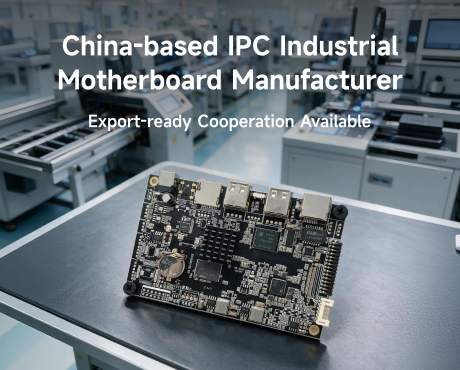
- China-Based Manufacturing: AndroidSBC produces in Shenzhen with in-house SMT lines, AOI inspection and a 72-hour continuous burn-in rack that cycles every finished board before packing
- Certification Transparency: CE, FCC and RoHS documentation is provided per model, and GMS-certified Android builds are available where the market requires Google services
- Tested Claims: 7x24 playback stability, power draw, network throughput and panel compatibility are verified on samples from every production lot, and the reports travel with the shipment
- Private Label Support: boot logo, launcher, firmware, enclosure, packaging and accessory bundles are customized for each program
- Global Shipping Experience: we pack for importers, retail chains, integrators, brand owners and trading houses across Europe, North America, the Middle East, Asia Pacific, Africa and Latin America
Technical Specifications
| Parameter | AndroidSBC Specification |
|---|---|
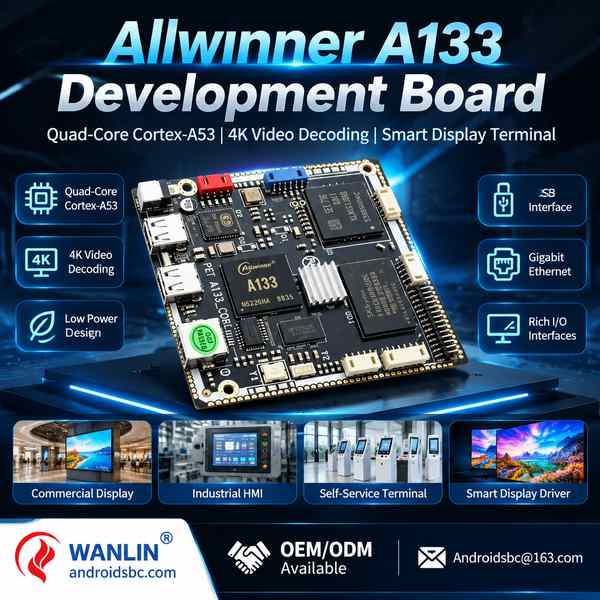
| SoC Platform | Allwinner A133 quad-core Cortex-A53, 1.6GHz, 64-bit |
| Operating System | Android 10 |
| Memory | 4GB LPDDR4 |
| Storage | 64GB eMMC 5.1 |
| Display Output | LVDS or MIPI-DSI panel drive up to 1080p |
| Serial Ports | 3x TTL with RS232 option |
| USB | 2x USB 2.0 host, 1x USB OTG |
| Expansion | GPIO, I2C, SPI, PWM for sensor and relay control |
| Environmental | -10 to 55 degrees C commercial |
| Certification | CE / FCC / RoHS, ISO 9001 factory quality system |
Application Scenarios for Global Market
| Application | Model | How It Helps the User |
|---|---|---|
| Factory machine operator panel | AS-A133-HM10 | Shows machine status on a 10.1-inch panel and logs alarms over RS232 |
| PLC companion touch screen | AS-A133-HM10 | Runs an Android HMI app that talks Modbus over the serial port |
| Production line data terminal | AS-A133-HM10 | Collects station counts through GPIO and uploads them over Ethernet |
| Packaging machine HMI retrofit | AS-A133-HM10 | Replaces an aging control display with a documented Android build |
Certified Allwinner A133 Board Manufacturing for Global Markets
Buyers who ship containers of Android boards need more than a price list. The production and QC flow below is what lets a distributor open a carton and trust what is inside:
- 10,000-square-meter Shenzhen facility with four SMT lines, two AOI stations and a 72-hour continuous burn-in rack that cycles every finished board before packing
- REACH and RoHS supplier declarations for all PCB and component materials, with test reports kept for at least 5 years
Lot samples from every production run are burned in for 72 hours, measured for power draw, video output stability and network throughput before the cartons are sealed, and the numbers are recorded per serial batch. A buyer can request those records with any order.
Why Choose AndroidSBC as Your Allwinner A133 Board OEM Manufacturer
A buyer comparing AndroidSBC with a trading-house supplier and a brand-name competitor is really comparing four things: source-chip traceability, Android build control, panel compatibility and customization depth, and the table below puts those side by side.
| Factor | AndroidSBC | Typical Trading Supplier | Branded Competitor |
|---|---|---|---|
| Manufacturing depth | China-based A133 board factory with in-house SMT, AOI and 72-hour burn-in racks | Trading company, outsourced production | Brand owner, limited custom work |
| SoC and build control | Genuine A133 with date-code traceability; documented Android 10 or Linux build | Spec-sheet numbers, hard to verify | Marketing-led claims, no per-lot data |
| Certification support | CE / FCC / RoHS files plus GMS-certified Android builds on request | Incomplete documents, customs risk | Brand-level only, no per-order files |
| Customization | Boot logo, launcher, carrier board, memory and storage, enclosure from low MOQ | Stock models only | Fixed SKUs, no private label |
| Price (factory direct) | Tiered factory pricing with volume discounts | Unpredictable markups | Premium brand pricing |
Allwinner A133 Board OEM Process: From Inquiry to Shipment
An A133 board OEM project is shorter than a full appliance program, but the same five risk gates still apply: documentation, sample, customization, inspection and shipment. A standard A133 board OEM project then follows 8 steps:
- Tell Us Your Target Market - North America, Europe, the Middle East, Asia Pacific, Africa or Latin America; each market may require different certifications, manual languages and power supplies
- Select a Board Platform - our team recommends an AndroidSBC A133 board for your application and volume, or works from a reference unit you send
- Verify Documentation - request certificate files, burn-in logs and the panel compatibility list for the exact model before you commit
- Confirm Customization - boot logo, launcher, memory and storage, carrier board, enclosure and any display or I/O options
- Sample Evaluation - run a 7x24 playback test, a panel test and a network test on real samples before scaling
- Confirm Production - after specifications, commercial terms and OEM details are locked
- Quality Inspection - lot samples are burned in for 72 hours and every board passes the functional test before packing
- Shipment - cartons leave FOB, CIF or DDP according to the agreed logistics terms
Customer Testimonials
These are not paid reviews; they are condensed from post-shipment feedback forms that AndroidSBC buyers have sent after running a real deployment season.
- Lucas Meyer (Digital Signage Distributor, Berlin, Germany): "The A133 boards have run 7x24 in our menu network for 14 months with a 0.6 percent field-failure rate, and the per-lot burn-in log matched every batch we spot-checked."
- Aisha Rahman (Kiosk Program Buyer, Dubai, United Arab Emirates): "We asked for a custom carrier board with two RS485 ports and a CAN bus, and the team returned a working sample in 18 days from our reference schematic."
- Sophie Delacroix (Digital Menu Board Supplier, Tokyo, Japan): "The 4GB plus 64GB configuration ran our full-screen kiosk app without a single reboot in a 30-day field trial at 40 degrees C."
Frequently Asked Questions
Q: Can the board talk to a PLC?
A: Yes, RS232 and RS485 serial ports plus a Modbus-over-serial reference are supported, and GPIO and I2C are exposed for sensors.
Q: Does it run Linux instead of Android?
A: A Linux BSP with Ubuntu or Debian rootfs is available on request for HMI teams that do not want Android.
Q: What temperature range does it survive?
A: The commercial build is rated -10 to 55 degrees C, and the industrial option extends to -20 to 60 degrees C.
Q: Can you lock down the Android build so operators cannot break it?
A: Yes, kiosk mode, disabled settings and a read-only system image are part of the standard HMI configuration service.
Q: What is the minimum order for a custom carrier design?
A: Custom carrier board work starts at a 300-board commitment, and stock-model customization starts at 100 boards.
Project Summary
Bottom-line: By working directly with manufacturer AndroidSBC, the Digital Menu Board Supplier team in Tokyo reached 30% higher margins on its A133 board line while keeping program pricing competitive. With verified burn-in reports, real certification files, documented Android builds, honest panel compatibility and flexible OEM customization, AndroidSBC has become their trusted Allwinner A133 board manufacturing partner.
For more information: www.androidsbc.com | Export Service Hotline: +8613261677119 | Email: Androidsbc@163.com